
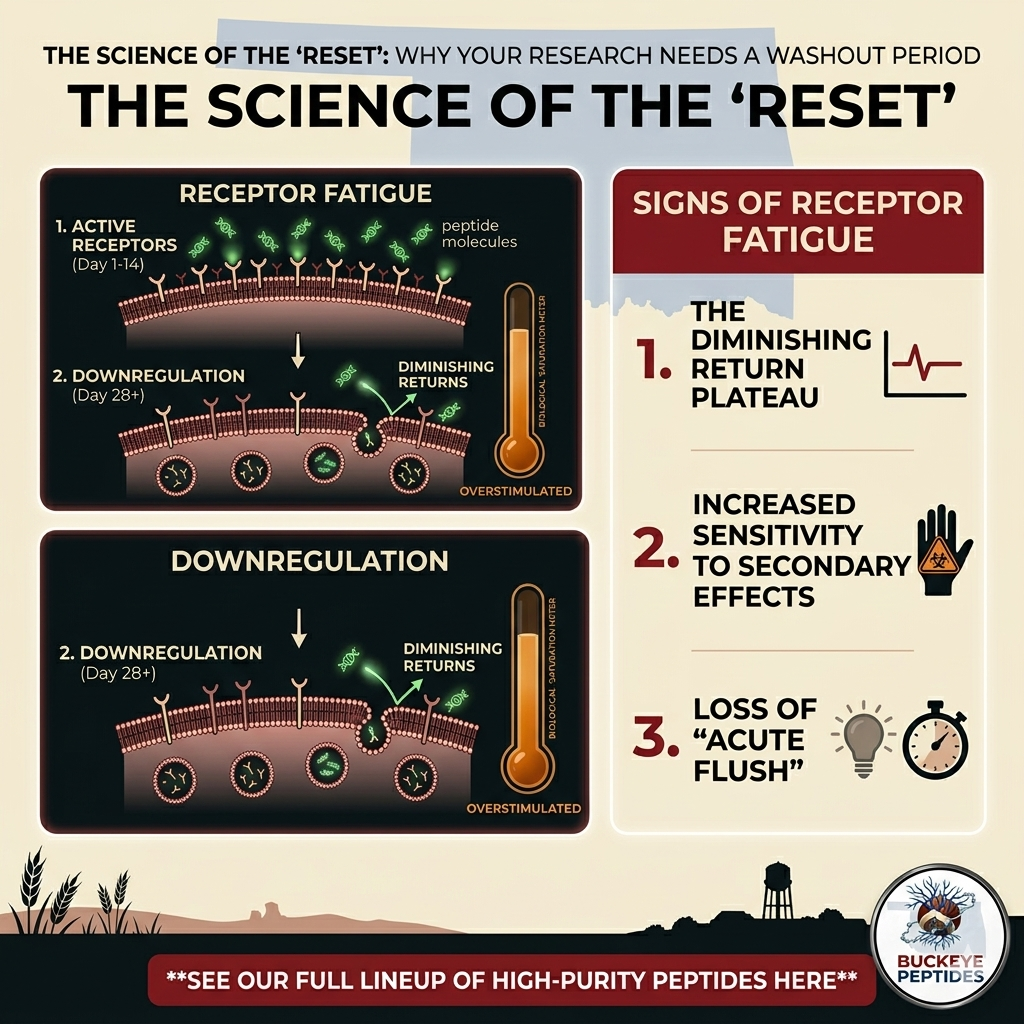
In the world of peptide research, more is not always better. Whether you are studying MOTS-c for mitochondrial efficiency or BPC-157/TB-500 for tissue repair and inflammation, the biological “lock and key” mechanism of your cells is subject to a phenomenon called Downregulation.
To maintain peak bio-availability, your protocol must include a Washout Period.
What is Receptor Fatigue?
Think of your cell receptors like a doorbell. If someone rings it once, you hear it clearly. If someone holds the button down indefinitely, eventually, you tune out the noise. This is “Receptor Fatigue.” When a peptide constantly saturates a receptor, the cell actually pulls those receptors inside (internalization) to protect itself from overstimulation.
3 Signs of Receptor Fatigue in Your Research
If you notice these three markers, it is time to transition into a washout phase:
- The “Diminishing Return” Plateau: You are following the exact same MG-to-BW ratio as Week 1, but the physiological markers (recovery speed, energy levels, or metabolic shifts) have flattened or regressed.
- Increased Sensitivity to Secondary Effects: Paradoxically, as the positive effects wane, some researchers notice an uptick in lethargy or localized sensitivity. This is often a sign that the body is struggling to process the peptide load.
- Loss of the “Acute Flush”: For peptides that typically offer an immediate metabolic or cognitive “lift,” a total lack of response suggests your receptors are currently “deaf” to the signal.
Strategizing your next research block? > Ensure your library is stocked for when your washout period ends. [See our full lineup of high-purity sequences here] > Buckeye Peptides: Precision Research for Oklahoma and Beyond.
How to Execute a Proper Washout
For most sequences, a 5-on / 2-off weekly schedule is a baseline, but a true “Reset” usually requires a 2 to 4-week complete break after an 8–12 week cycle. This allows the cell to “re-surface” those receptors, ensuring that when you begin your next round, your research remains as effective as the very first day.
Pro-Tip: Use this “off” time to revisit our Math 101 Guide to recalculate your upcoming requirements or check your current inventory against our Storage and Stability blog to ensure your refrigerated sequences stay viable.
Final Call to Action
Don’t let “loud” research lead to silent results. At Buckeye Peptides (Est. 2025), we provide the purity you need to ensure every cycle counts.
