
Introduction: The Dual-Signal System
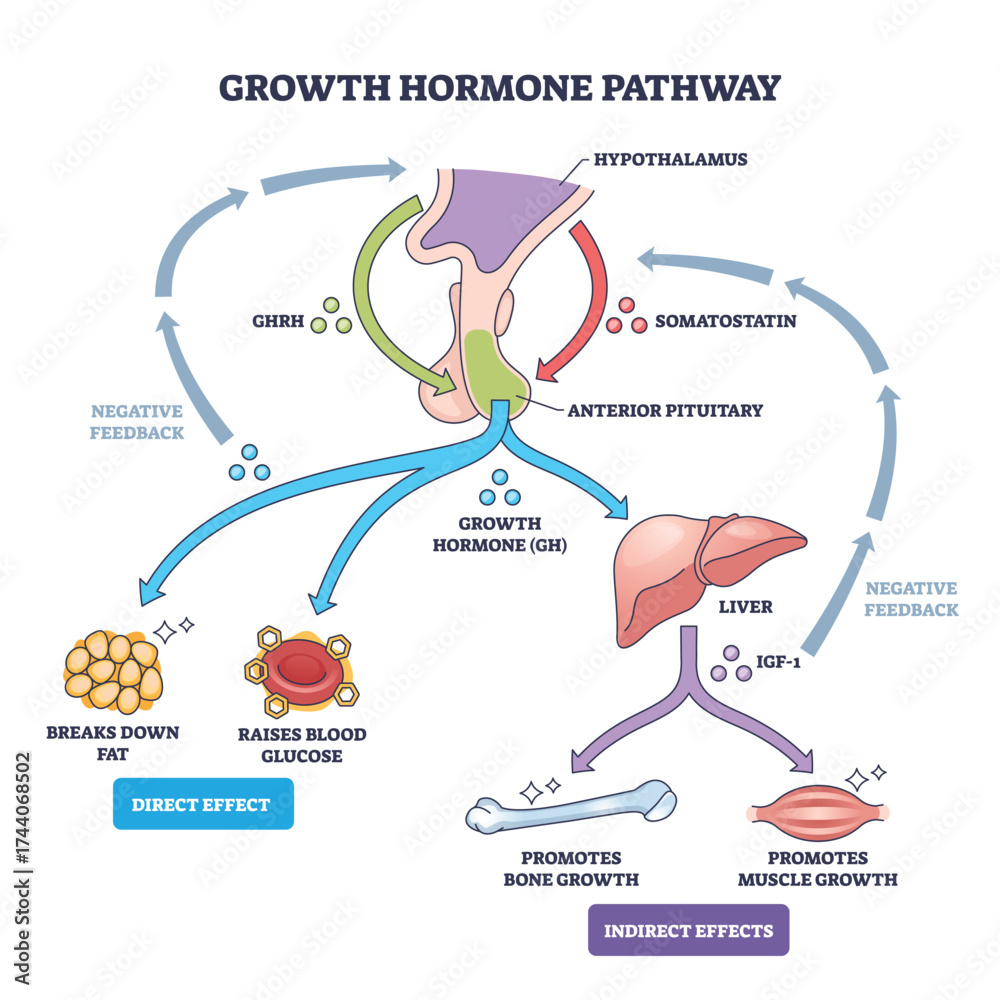
In the world of endocrinology and peptide research, the release of Growth Hormone (GH) isn’t a single event—it’s a carefully choreographed dance between two different signals in the brain. If you only use one, you’re only getting half the story. To maximize research outcomes, one must understand the distinction between Growth Hormone Releasing Hormones (GHRH) and Growth Hormone Releasing Peptides (GHRP).
1. GHRH: The “Signal” (The Architect)
GHRH analogs, such as Tesamorelin and CJC-1295, act as the primary signal. They mimic the hormone naturally produced by the hypothalamus that tells the pituitary gland: “It is time to produce a pulse of Growth Hormone.”
- How it works: GHRH increases the amplitude of the GH pulse. It ensures that when the “gate” opens, there is a significant amount of hormone ready to be released.
- Research Focus: GHRH analogs are prized for their ability to support the body’s endogenous rhythm without overriding it, making them ideal for long-term metabolic study.
2. GHRP: The “Gas Pedal” (The Catalyst)
GHRPs, such as Ipamorelin, work on a different pathway entirely—the Ghrelin receptor. They act as the catalyst that actually triggers the release.
- How it works: GHRPs increase the number of pulses and inhibit Somatostatin (the “brake” hormone that stops GH release). If GHRH is the signal to build the hormone, GHRP is the command to fire it.
- The Precision of Ipamorelin: Unlike older GHRPs (like GHRP-2 or GHRP-6), Ipamorelin is highly selective. It stimulates GH release without significantly spiking cortisol or prolactin, making it the gold standard for clean research data.
3. The 1+1=3 Effect: Why We Stack Them
This is where the most compelling research lies. When a GHRH (the signal) and a GHRP (the catalyst) are administered together, they create a synergistic “Double Pulse.”
- GHRH ensures the pituitary is fully stocked and ready.
- GHRP clears the path by silencing the “stop” signals (Somatostatin).
- The Result: A significantly more potent GH release than either compound could achieve alone, even at higher doses. This is why the CJC-1295 + Ipamorelin blend is the most studied combination in the industry.
4. Strategic Timing and Saturation
For researchers, timing is everything. Because these peptides mimic a natural biological pulse, research is often conducted during “nadir” periods (low points in natural secretion), such as before sleep or upon waking. Understanding the saturation dose—the point where the receptors are fully occupied—is critical to preventing material waste and ensuring clean data sets.
Conclusion: Mastering the Axis
Choosing between GHRH and GHRP isn’t necessary when you understand that they are two parts of the same machine. By leveraging both pathways, researchers can achieve a level of physiological optimization that single-compound protocols simply cannot match.
Ready to observe the synergy in your own lab? [Click here to view our 5mg/5mg CJC-1295 & Ipamorelin Blend]
